Search or browse all guides
Quick visual guide
Follow the three numbered blocks, then review the output controls.
- 1
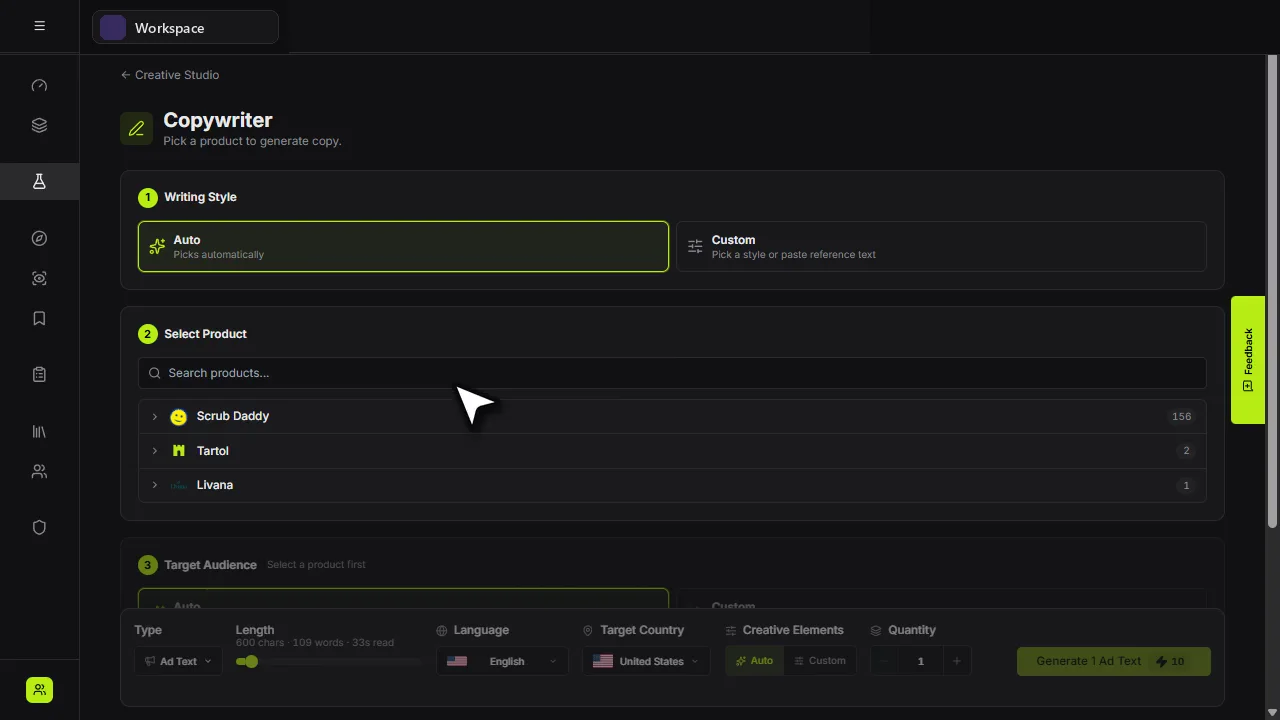
1. Select Product
Open the saved brand and select the product the copy should sell. The next steps unlock once a product is selected.
 Pick the product
 - 2
2. Choose Writing style
Use Auto to write with language from your customer research, or Custom to paste a reference text to sound like.
Auto or Custom - 3
Finish the setup
Choose the customer strategy, then set type, length, language, country, and quantity.
Review outputs
Red labels show the exact control to use.
Watch the full walkthrough
Detailed referenceOpen this for definitions, limits, examples, and troubleshooting.
Create copy from your product
- 1Choose the productCopywriter loads the saved product context.
- 2Select the format and goalChoose the platform or output type and the message you need.
- 3Choose audience and angleUse saved strategy or provide focused context. A saved Custom audience supplies the same audience text used by Image Ads, while Copywriter applies it to the writing rather than visual casting.
- 4Review output settingsChoose the type, length, quantity, language, and target country. Copywriter uses on-brand intensity and the configured default model; Go aggressive and Uncensored AI are no longer available in the browser.
- 5Review and generateConfirm the displayed credits, then wait for the result in Copywriter history.
Writing styles do not choose the customer strategy
Output settings appear at the bottom of Copywriter, below the setup steps, with controls arranged across the available width. On wide screens, compact controls keep Quantity and Generate on the same row as the other output settings. Controls wrap on narrower screens, and Generate follows the settings on mobile. Settings can be edited before selecting a product; Generate becomes available when the required selections are ready.
In Writing Style > Custom > Styles, choose Storytelling, Punchy, or Explanation. These choices control narrative, wording, and pacing, not the audience or selling argument. Offer, Objection Crusher, and Problem Solution are no longer independent style choices. Their historical tags and saved references remain available; nothing is deleted. Reference text also remains available for pasting an example.
- In the legacy workflow: Choose one writing style at a time. Selecting another replaces it, and clearing it does not change your copy quantity. Every copy in the batch uses that chosen style. Customer Strategy uses Writing approach instead, without collection styles. Public REST and MCP keep their existing multiple-reference contracts for compatibility.
- In Custom Customer Strategy, Recommended length appears when the ticked truths have too many developed points for a short result; context-only truths are excluded. It estimates the space needed to develop all selected truths. It is a rough editorial suggestion, not a limit or a rule from the course: allow about 300 characters for framing plus 300 per developed point. Context-only identifications or characteristics may need no extra space. Keep your length and let the writer focus, remove truths, or click Use recommended length to update the Length slider and its credit estimate. Nothing changes automatically.
- Customer Strategy copy uses one final-writing call with Abliterated Large v2 through the direct Abliteration API. It uses the selected research, the idea connecting the ticked truths, a focused set of product facts and original customer language. The writer follows a Big 4 doctrine (New/Only, Easy/Anybody, Safe/Predictable, Big/Fast, from the book Take Their Money) and the awareness-stage strategy from Breakthrough Advertising. In the same call it writes three hook candidates from hook patterns that fit the reader's awareness stage and picks one. It then writes the body as beats, each tagged with the emotions it carries and the truths it uses. The copy is assembled from the chosen hook and those beats, so every visible part carries at least one emotion. Tartol records any part left untagged and any selected truth or objection left unused. There is no automatic editor, separate review, hook-generation call or length-repair call; checks are local and do not verify sentence-level emotional coverage beyond those tags.
- Angles and the writer share short NESB teaching excerpts from Take Their Money. Angle labels are New / Only, Easy / Anybody, Safe / Predictable and Big / Fast. Every copy sentence must carry at least one of these emotions, including informative lines and the CTA. That requirement does not permit invented claims or imply machine-verified emotional coverage. Existing research, selected angles and previous copies are not regenerated automatically.
- Customer Strategy hooks lead with a supported opportunity or useful insight from the selected truths. Wanting a benefit is not evidence that the reader suffered its opposite: the writer must not invent past events, mistakes, time lost or personal experiences to create a relatable opening. UGC means spoken presentation, not an invented customer testimonial. There are no built-in fictional copy examples; source wording and explicitly supplied references remain available. These are instructions inside the same single writing call, not a separate paid review or a guarantee that every response follows them.
- The writer adapts original passages and phrases attached to the selected truths. These are customer language, not testimonials or proof about the product. All selected truths remain saved; primary and supporting points develop the argument while context informs understanding. Historical copies can still show their original Customer writing plan; new copies save the selected strategy without generating another plan.
- Custom Customer Strategy has no truth-count or per-category cap: tick any number of saved truths applicable to the chosen audience and awareness. Before writing, Tartol forms one idea that connects the ticked truths; if no single idea fits them, the copy is written from the truths directly instead of failing. Normal request-size and model-context limits still apply.
- Customer Strategy determines the audience, awareness stage, selected customer truths, and resulting angle. Presentation expresses that strategy without replacing it.
- New selling angles explicitly record what the reader already understands, where the argument starts, and what it helps them understand next. Expand NESB and argument details to inspect that progression. Unaware begins with a recognizable situation; Problem aware helps explain the problem and introduce an approach; Solution aware makes the approach worthwhile; Product aware addresses specific-tool fit; Most aware addresses the actual offer or adoption decision. Familiarity with a competitor does not imply familiarity with your brand. The existing angle reviewer rejects awareness mismatches without automatically generating replacement batches.
- NESB strengthens the hook, argument and close through useful novelty, effort removed, reasons to believe and a meaningful payoff. The single writer develops the full argument and tightens its opening in the same response. No separate editor, hook-generation call, self-scoring audit or automated rewrite follows it.
- The awareness/NESB strategy update does not delete research or previous copies and needs no research rebuild. The writer prepares the idea that connects the ticked truths when you generate copy; merely browsing never starts paid generation. Earlier explicitly selected angles and in-flight jobs remain readable and keep their original strategy. New copy uses the strengthened editing instructions; old generated text is not rewritten automatically.
- Copywriter has no preset writing styles. Writing style Auto uses language from your customer research: the selected angle, awareness and real customer language guide the copy. Custom uses the tone, language and structure of a reference text you paste (required in Custom); it supplies compatible presentation, not a different argument or product claims.
- Customer Strategy copy uses one final-writing call with Abliterated Large v2 through the direct Abliteration API. It uses the selected research, the idea connecting the ticked truths, a focused set of product facts and original customer language. The writer follows a Big 4 doctrine (New/Only, Easy/Anybody, Safe/Predictable, Big/Fast, from the book Take Their Money) and the awareness-stage strategy from Breakthrough Advertising. In the same call it writes three hook candidates from hook patterns that fit the reader's awareness stage and picks one. It then writes the body as beats, each tagged with the emotions it carries and the truths it uses. The copy is assembled from the chosen hook and those beats, so every visible part carries at least one emotion. Tartol records any part left untagged and any selected truth or objection left unused. There is no automatic editor, separate review, hook-generation call or length-repair call; checks are local and do not verify sentence-level emotional coverage beyond those tags.
- Customer Strategy supplies the selected product-source statements, relevant offer facts and source-linked customer wording in a focused brief. The landing page does not dictate the audience psychology or voice. Seller descriptions establish described capabilities, not independently verified performance. Supported practical deductions can be stated confidently; another advertiser's results cannot be transferred.
- Before showing new selling angles, the review can correct an overstated sentence when the underlying idea is sound, then check the corrected angle. It cannot change the selected truth references or invent evidence. Research-only argument steps cite their customer evidence rather than unrelated product claims. Once you choose an angle, Tartol keeps its known strategy metadata itself, so the writer can focus on the new plan and copy. A script can demonstrate supported product actions, but cannot invent demonstration results.
- In Customer Profile mode, Writing approach replaces the style picker. Leave Adapt a reference instead unchecked for the research-led baseline; deliberately enable it to paste a script or ad. An empty reference uses the baseline. Collection styles and house-style DNA are not injected. The reference can guide compatible presentation, but customer vocabulary, the approved argument and awareness still take precedence. Legacy seed mode retains Writing Style and its existing reference contracts.
- Current revision-8 angle batches review four strategy sections: one idea, awareness plan, product connection and desire-to-payoff path. They lead with a meaningful desired change and an entry the selected audience can recognize, rather than pitching features one by one. Capabilities explain the route to that outcome. Ad runtime alone does not prove that a competitor ad was profitable or validated. A review marked accepted while listing unresolved claims gets the existing one bounded paid correction; if it remains contradictory the batch pauses instead of publishing a misleading angle. The final writer applies NESB and develops the argument in one call; angles do not prewrite NESB passages or scripts. A plausible deeper payoff is labeled as inference unless the selected customer evidence actually supports it. Strong delivery does not make unsupported implied results acceptable. Historical angle revisions and completed paid responses are preserved.
- A generated copy keeps the idea and truths it used. In its preview, Research behind this angle shows the read-only Main, Support and Context truths in the original full-width category table, and View all customer truths expands the broader library. No checkbox implies a second choice in this view. Historical angle details remain available.
- Selling angles and Customer Profile scripts make the strongest supported case: supplied capability → work removed → reader payoff. A credible process-level explanation does not require a comparison study, and direct capabilities should not be padded with may help language. For self-serve ad variations, Skip the freelancer briefing describes work removed; it does not establish 10 ads in 10 minutes, guaranteed savings, profitable competitor ads or a higher hit rate. Connected reporting means the specified information is brought into the workflow, not more accurate data than its source. The copy must not invent evidence. NESB and argument fields emphasize positive supported alternatives; Evidence limits remain internal boundaries. Existing saved angles are not rewritten or regenerated automatically: new batches use the updated preparation guidance, while future scripts also use it within the approved angle.
- Browsing Custom Customer Strategy is read-only: opening it or switching awareness stages, target audiences or ticked truths never starts an AI request, and neither does Retry loading. The writer prepares the idea that connects your ticked truths only after you click Generate copy, and Auto does the same.
- For a new selling-angle draft, Tartol derives research-backed versus User added labels from the saved customer truths rather than asking AI to classify those labels again. A scoped truth already cited in an argument is included in the angle foundation, and duplicate references are reconciled without changing the idea or its wording. This bookkeeping does not add evidence: unknown IDs and unsupported product facts still fail validation, and the independent review can reject an incoherent connection or unsupported claim. Approved angles and manual copy selections remain locked and strictly validated.
- The finished writing response is saved before technical validation. A lost or invalid paid response does not buy another writing call. Confirmed unbilled provider rejections can resume after backoff. Complete historical writer/editor checkpoints can replay without any new provider call; an unfinished old draft is preserved and requires a new generation to use the new workflow, rather than being mislabeled as a finished script.
- Selling-angle requests use explicit medium reasoning effort and leave room for a complete answer: up to 12,000 output tokens each for drafting and review, including reasoning. These are ceilings, not a required spend or a copy-length restriction. A token-limit cutoff or empty completion stops immediately without repeating the same paid request; only a received, non-empty answer with fixable validation errors may get one targeted correction. The error identifies an output-limit cutoff when the provider reports it. Try a new batch requires an intentional confirmation; refreshing cannot restart a failed batch. Customer evidence, NESB checks, and independent review are unchanged.
- If a single-pass response misses the requested length after formatting, Copy needs attention shows the mismatch. The paid response stays intact; Tartol does not buy an automatic length repair or truncate the script. Technical validation is not a factual or conversion-quality verdict.
- Copy writing uses Abliteration directly with Abliterated Large v2, including Customer Strategy copy, legacy copy, selling angles, hooks, rewriting, translation and image-concept text. Customer Strategy still uses one writing call without an automatic editor or length-repair call; angle preparation retains its separate cached draft/review workflow. Research, analysis, transcription and image rendering keep their existing providers. Old Claude/Venice model flags cannot change this writing route, and new requests do not buy duplicate A/B-model outputs. Super admins manage Abliteration credentials in Key Pool & Rotation; a server-only ABLITERATION_API_KEY can bootstrap a provider with no pool entries. Public API and MCP copy actions use the same routing and credit rules as the website; they cannot administer provider credentials. Provider interruptions preserve the original job and completed work. Confirmed unbilled rejections may resume after a delay; ambiguous paid responses need reconciliation, not blind repeat calls. Model selection is not a speed or conversion guarantee.
- Ticking only desires is valid. The writer must not invent an objection, pain, or unselected belief to fill a template. A notion is a belief to agree with or honestly reframe, not an objection; objections are hesitations about buying or trusting a product like this.
- Offer emphasis and objection handling are optional. They must fit the selected message and awareness, and any offer terms or proof must come from verified product facts.
- In Customer Profile mode, a reference keeps its compatible voice, dialogue, rhythm, and formatting. Conflicting offer-first, objection, pain-agitation, or closing beats may be adapted or omitted. Customer strategy takes precedence.
- Customer Profile video scripts use a natural opening, development, and close without mandatory six-section or fixed 40-second scaffolds. Referenced scripts keep their compatible source structure; legacy seed scripts retain their existing format.
- Public REST and MCP retain the approved-reference ID and reference-text contracts. Historical tags remain valid; Customer Profile controls are available to eligible workspace users; REST and MCP support versioned Customer Profile copy inputs. Tartol Agent can explain the workflow but does not change the strategy for you.
On-brand copy
Copywriter uses on-brand intensity and the configured default model. Go aggressive and Uncensored AI are no longer browser options. Legacy REST API and MCP inputs remain supported for existing clients; this compatibility does not expose these controls in Copywriter. Copy must not invent or strengthen product capabilities, outcomes, comparisons, numbers, timeframes, testimonials, guarantees, discounts, deadlines, scarcity, or proof. Audience research describes what readers think and want; it does not prove that the product delivers a claim. Copy uses the selected product evidence, reference structure, and customer-profile combination when those inputs apply.
- On-brand is the default. It keeps emotional intensity and claim strength close to the saved product and brand context.
- Copy builds one coherent selling idea. It does not force unrelated or conflicting audience datapoints into one script.
- Review factual, regulated, and platform-policy-sensitive claims before publishing.
Clone a transcript structure
Use a transcript when its pacing or persuasion structure is useful. Tartol adapts the same narrative device, beat order, progression, and closing method to your product instead of replacing them with a generic framework. When a newly transcribed spoken source contains multiple detected speakers, the cloned reference and generated script preserve the visible Speaker 1, Speaker 2, and subsequent turn labels; a single detected speaker remains unlabeled. Transcripts containing sung vocals also remain unlabeled so one singer’s changing pitch is not mistaken for several people. It does not add HOOK, PROBLEM, CTA, timestamp, or other visible section labels unless the source already uses them. Reference clones skip unrelated customer-voice seed research, while still loading the product and audience context needed for accurate copy. The reference-text card stays compact: choose Read more to open the source in the full-screen copy reader, where reference details include only length, read time, and Copy, or use Copy text on the card to copy the untouched source. Review every factual and legal claim before publishing.
When customer research is still running
The displayed estimate adds a four-minute research allowance only when the job actually schedules new product, audience, or customer research. When saved research is ready and reused, the estimate shows only the writing allowance of about one minute for every started 1,500 characters requested. Actual timing can vary with the provider and output length. Tartol waits for a terminal research result and reuses that same run if a worker must resume, so leave the job processing and check Copywriter history rather than submitting another generation.
When the Customer Profile option appears
While research identifies audiences, each placeholder shows a moving magnifier revealing a person through a dotted field, with the status centered below it. Active audience cards use the same animation and show their live research status in the center, with name and percentage below. The animation stays still when reduced motion is preferred. Customer language shows real discussion titles and comments as they arrive, without illustrative placeholder cards.
A malformed final summary can be repaired without repeating customer searches: Tartol rewrites or splits only the affected group, preserves every supporting point, and validates it again within the existing research budget. It never drops evidence merely to make completion succeed.
New research uses original Reddit posts and replies; previously saved profiles may also contain YouTube comments. Original post text is reused from the same provider response and kept verbatim with its own author and source link. Every eligible collected post and reply is analyzed, without a fixed 480- or 800-source sample. Tartol assesses the whole speaker before extracting snippets and checks identities independently against the original words: advice to a store owner does not make the adviser a store owner, and learning from a course does not make someone a course seller. Relevant buyer motivations, values, and beliefs can inform copy without mentioning a product feature; they never become a claim that the product solves every concern.
Customer Profile copywriting, Customer Research in Brands, and audience inspection in generated-copy previews are available to all signed-in workspace members. Viewers can inspect saved research; creating research, generating copy and preparing selling angles require use_ai_tools, and editing audiences or customer truths requires manage_brands. Existing subscription, credit and connection-scope checks apply. Starting or retrying full customer research costs 95 credits. There is no Research again: Delete research (in the ⋯ menu of the research window) is free and removes the research for everyone in the workspace, so it can be started fresh. Viewing saved research is free; opening the modal does not start paid work. Each added researched audience costs 10 credits; explicitly generated selling angles cost 10 credits each. Public REST and MCP expose saved Customer Profile evidence and the stable Reddit-discovered audience candidate list through product_strategy, and accept researchSystem: ivoc_v1 in generate_copy with automatic strategy or a versioned ivocSelection. Omit researchSystem to retain seed compatibility. create_product_audience accepts optional researchCustomerTruths: true to save an audience and request its focused Reddit study; this also requires use_ai_tools. New research does not gather YouTube customer truths; historical evidence remains readable. A discovered candidate can be added using its saved identification and name; the candidate percentage remains fixed until another product discovery pass. The response distinguishes a saved audience from research that could not start. product_strategy exposes saved applicability separately from observed source awareness. Editing or deleting customer truths, deleting target audiences, Delete research, portrait synchronization and explicit selling-angle batch preparation remain browser actions: those operations change or remove shared evidence or reserve separate provider attempts and do not yet have version-bound programmatic action confirmations. Private provider checkpoints and credentials are never public actions. Tartol Agent explains these choices and routes users to the UI or MCP; it does not mutate research.
Customer Strategy is audience first, awareness second, then the customer truths your copy speaks to. Picking an audience selects Problem aware by default, or the nearest stage that has truths for that audience. Tick truths yourself or use Random pick to tick one or two from each category; truths are sorted by how many comments from that audience mention them. In Customer Research on Brands, Create ad asks whether you want an image ad, a video ad or copy, then opens that form with the product and Custom strategy already selected; finish the remaining settings, then Generate. There is no separate selling-angle step: the writer forms one idea that connects the ticked truths. In Image Ads, including cloned ads, the product needs customer research before ads can be generated; Generate never starts or pays for research. Until research is done, the research view appears below Auto so it can be started or retried there, and ads requested while research runs start when it finishes. Cloned ads use your customer research for the angle and copy, and copy the reference ad’s look for the image: the angle keeps the reference ad’s kind of message and makes it about your product with the truths and words that fit it, while the picture keeps the reference’s scene, photo style, people and text presence. Browsing never starts AI work.
Customer research costs 95 credits for a full study. Adding a researched audience costs 10 credits. Viewing and reusing saved research is free. Automatic job deliveries reuse one credit receipt instead of charging again. AI and scraping provider usage is separate; normal accepted copy/image generation credits still apply.
Research again intentionally rebuilds a ready product profile. Normal generation reuses it; adding an audience starts a focused study instead of repeating all product research. Retry research starts a fresh attempt, refunding any remaining research charge on the retired interrupted job first. Automatic provider recovery keeps the original job and checkpoints without a second charge.
New Customer Research searches five Google pages per problem query, checks every discovered subreddit for current activity and multiple relevant discussions, and identifies strongly audience-specific communities. It saves every supported audience candidate, initially researches the five strongest identities, and keeps narrower identities such as Shopify store owner separate from parent identities such as ecommerce owner. The percentage pill is a fixed share of problem-relevant Reddit discussions and capped independent commenters in the qualified discovery evidence; it does not change as focused research runs or estimate all people with that problem. Broad or unclear sources stay in a diagnostic group rather than being forced into a target audience. A strongly targeted subreddit can support contextual audience association without pretending a commenter explicitly stated their role. The targeted pass researches the selected audiences with Reddit discussions only; YouTube customer-truth collection is paused until video commenters can be attributed to audiences reliably. Previously saved YouTube evidence remains readable. Repeated truths become stronger evidence while distinct rare truths remain. Add audience lists saved discovery candidates and also accepts a manually described audience. Adding one starts a focused Reddit study when the product library is ready and no other study is running. Existing comments are deduplicated. Interrupted research offers Retry research, which starts a fresh attempt for the same product or audience and keeps completed research available. Automatic provider backoffs retain their existing checkpoints. Starting, retrying or rebuilding full customer research costs 95 credits. Saved research remains free to view and reuse. Adding a researched audience costs 10 credits; explicitly generated selling angles cost 10 credits each. Unfilled angle slots are refunded. Normal copy-generation credits still apply. Research aims for useful truths in every substantive category but never fabricates evidence to fill a cell.
A comment’s observed awareness and identity stay attached to its source. A researched truth appears only with supporting comments from the selected audience. Similar truths can repeat across audiences, with their own mention counts. AI separately estimates which stages fit the truth itself; several stages can fit, including its opening or supporting role. Within each category, the table sorts by audience-specific mentions, highest first. Stage-fit percentages are not displayed or used for table ordering. There is no stage-exclusivity checkbox. Mention counts stay independent of awareness stage. Similar competing products count for research relevance without claiming familiarity with this brand. Browsing saved research never buys relabeling or rewrites evidence. Auto ranks strong audience/message opportunities before rotating for variety, without a quota for every awareness stage; Most aware requires an explicit choice, not an assumption that competitor buyers want this brand.
New selling angles include the immediate desire, deeper payoff, and connection between them, marked as customer evidence or an inference. The angle and one-call writer sell the strongest meaningful outcome the product can credibly help achieve, not a list of features. The opening helps the intended customer recognize their identity, desired change, belief or experience from the research; a literal audience callout is optional. Product capabilities explain how the desired change becomes possible. Confident practical deductions do not need unnecessary disclaimers, but unsupported results cannot be presented as expected through either direct wording or implication. Ad longevity alone does not establish that a competitor ad was profitable or proven. The writer brings the relevant payoff into or near the hook, without assuming every audience ultimately wants money. NESB shapes the finished copy; new angles no longer prewrite NESB passages or a miniature script. Angle drafting and review may each make one paid correction for an invalid response; a contradictory review verdict is invalid and cannot silently approve or reject an angle. This does not guarantee model compliance or conversion performance. Historical angles and completed paid checkpoints remain reusable.
Customer language is one audience-specific panel of verified words and phrases, not a second list of quotes categorized as desires or shared-market wording. Full comments remain in each truth’s supporting evidence. Phrase counts include only actual occurrences in the selected audience, including its sub-audiences, independent of awareness or truth selection. Speaking patterns require at least three distinct comments and 20% of the available sample; missing patterns are not invented. The final writer receives up to eight source-verified expressions from the selected audience (sub-audiences included), with wording tied to the selected truths first, supported speaking patterns and eight balanced raw comment excerpts. It borrows vocabulary and rhythm naturally without forcing keywords, copying whole comments or fabricating testimonials. Saved research works without a rerun, migration, extra AI call or extra credit charge. Brands, Copywriter and Creative Studio research previews share this panel.
The Customer Research header shows the Reddit posts and comments analyzed. An older saved profile also shows its YouTube count when it contains YouTube evidence; new research does not collect YouTube comments.
The Customer Profile system is available to all signed-in workspace users, with normal role and subscription permissions. New profiles use verbatim Reddit posts and comments, then separate materially different evidence-backed audience Identifications into tabs. The same profile classifies customer truths across Unaware, Problem aware, Solution aware, Product aware, and Most aware. Product aware includes people discussing this product or close named tools serving the same job. The normal Copywriter research system remains the default for every other account.
While research runs, the modal keeps the same four sections as the finished view: Target audience, Awareness stage, Customer truths, and Customer language. Before audience discovery finishes, Target audience shows neutral placeholders; then up to five observed audience cards fill in with short role names, stable discovery percentages, and their own real discussions-found, comments-gathered, and comments-analyzed status. Expand a broader audience card to see supported narrower audiences. Portraits arrive with the finished profile; placeholders do not pretend an image was generated early. Awareness and truths remain visibly unavailable until their evidence is ready, and live Reddit comments appear under Customer language without pretending recurring phrases have already been grouped. The whole-job percentage advances only on actual milestones, never elapsed time. Completed search batches, Reddit pages, classification batches, and synthesis results are saved as durable operation checkpoints alongside the persistent provider budget. If a worker restarts, Tartol replays completed operations and continues the same research job. An interruption is shown rather than leaving an apparently frozen progress display. This progress layout is browser presentation; saved research reads through public REST and MCP retain their existing contracts.
Classification progress is cumulative across primary and adaptive-expansion comments: each completed extraction batch increases the analyzed count without replacing earlier work or moving the whole-job milestone percentage backward. Scraper results publish gathered comments as discussions complete, and the feed rotates through up to 200 distinct real comments instead of repeatedly showing a ten-comment sample. The single whole-job header shows the active phase and counts; selected audience cards show their own discussion, collection, and analysis status without a second progress bar. A long provider call can still leave a genuine quiet interval, and the milestone percentage is not a clock or an ETA.
Customer Strategy replaces duplicate audience and angle steps. Auto ranks strong audience/message opportunities and rotates distinct ideas without awareness quotas. Custom expands inline: choose an audience first (Problem aware is selected by default, or the nearest stage with truths), then tick the customer truths, sorted by audience mentions; Random pick ticks one or two per category. Stage changes keep the audience. Generate uses the ticked truths, and the writer forms one idea that connects them. On Brands, Create ad asks whether to make an image ad, a video ad or copy, then opens that form with the product and this Custom strategy already selected. New audience descriptions get an automatic short name and portrait plus focused research when available. User-added truths remain labeled, with no fabricated mentions. Customer language shows audience-specific words, phrases and repeated speaking patterns; full quotes stay in supporting evidence, not a separate language list or fabricated testimonials. The final copy uses one writing call with no editor or length repair. Research and angle preparation do not add workspace credits, but providers can charge for their requests.
Product Intelligence and landing-page fields are seller-page orientation, not customer evidence. They identify the offer and set the factual claim boundary, but their saved audience, pains, desired outcomes, benefits, differentiators, objections, proof, scanner demographics, and wording are not forced into Customer Profile copy. Initial planning searches Reddit for problems without assuming buyer identities. Strong audience-specific communities in the resulting discussions establish audience candidates. The focused pass then searches those observed identities across lived problems, methods, alternatives, and decisions. Roles, business models, ownership or care relationships, vocations, and specific life situations are valid primary identity lenses; experience, budget, workload, volume, and team size are secondary traits. Every atomic datapoint retains its source and awareness evidence; strongly targeted subreddit context can support audience association without claiming the commenter personally stated that role. Customer Profile supplies the customer psychology and message; product context keeps the result truthful.
New Customer Research uses Reddit for both problem-led audience discovery and the audience-focused customer-truth pass. YouTube collection is paused because the current workflow cannot reliably establish who a video commenter is from video context. Previously saved YouTube evidence remains readable. The audience percentage uses the same qualified, problem-relevant Reddit discussions and capped independent commenters as the ranking; unrelated communities and one oversized thread cannot inflate it. The percentage is fixed after discovery and does not change as deeper research runs.
If the primary Google discovery window returns no Reddit thread URLs, Tartol uses the same bounded three-zone fallback without the brittle custom-date filter. A rebuild can also reuse the product’s previously audited Reddit thread URLs as discovery candidates; their comments are fetched and classified again before any customer truth is accepted. Incomplete or error-shaped search batches are reported as provider failures instead of incorrectly claiming that no relevant customer discussions exist, and an empty search response never marks an API key as exhausted by itself.
- Every selected comment receives a product-specific editorial review for desires, causal beliefs, trust preferences, objections, alternatives, identity, situation, and vivid wording. Advice and troubleshooting can be strong evidence. A truth may connect through one to three credible causal steps rather than a literal feature match: for example, weak or fatigued creative can contribute to high CPM, and faster creative variation can create more chances to find stronger ads. The stored bridge must use cautious influence language, never invent a capability, claim a sole cause, or guarantee the downstream result. Generic platform history, unrelated security issues, third-party ad clutter, and other adjacent facts are excluded when no credible chain reaches the product.
- Awareness cards show a group-of-people indicator with fewer people toward Most aware and an instant Potential audience size tooltip. The indicator illustrates the awareness pyramid rather than measured market sizes or research counts. Relevant shared truths appear in the main table only with supporting evidence from the selected audience; that audience’s actual comments determine mentions, never global totals. A parent includes its sub-audience evidence without counting a comment twice. Editorial applicability determines which stages a truth fits independently of source-comment awareness. Within each category, truths with the most supporting comments from the selected audience appear first. Stage-fit percentages are not displayed or used for ordering. Truths may fit several stages; the former exclusivity checkbox is removed. Browsing never buys relabeling. Supporting comments stay scoped to the audience. The final profile tallies paraphrases by underlying meaning, while preserving every supporting source. Each category is tallied separately, and every extracted point must be assigned to a summary or rejected with a reason; missing assignments stop completion. Distinct useful singleton ideas remain available. Product aware includes directly similar products; its Knows products like yours subtitle is explained by the help tooltip. Most aware means wanting this product or a specific similar one, not merely being educated. Search lenses are collection directions, never evidence of buying intent.
- Before grouping, an independent source review re-reads the original comments to correct mistaken categories, speaker identities, or awareness labels. A helper can express a useful belief without describing their own situation; supplier pitches are not independent customer demand or buying intent. Customer language combines verified market vocabulary and intact expressions, including vivid one-off wording with its honest mention count. Counts come from actual source occurrences. The preview mixes words and phrases instead of letting generic single words fill every slot. These improvements use the existing research workflow and do not add a separate research charge.
- Super Admin AI settings expose Customer Source Reviewer separately from Customer Profile Synthesizer. Extraction, independent source review and category synthesis default to GPT-5.6 Luna. Extraction reads every eligible collected source in batches of up to 40; independent review re-reads useful sources in batches of up to 60. Category synthesis assesses all five awareness stages without changing source-backed counts. Those estimates remain internal; the table is ordered by audience-specific mentions. Initial searches cover five research lenses twice each; focused searches cover all five per supported main audience, using its observed context and relevant communities. Existing provider budgets, strict outputs and evidence validation remain in place.
- Comment ordering uses evidence-quality signals, upvote percentile within each thread, search-zone and source diversity, and diminishing returns for repeated comments from one thread. These signals determine processing order, not which eligible collected comments are analyzed. Lower-awareness discovery queries reject later-stage shopping language, while separate product-level searches collect solution, product, and buying evidence. A thread found through several searches retains every search-zone path for source planning. Raw upvote totals are never compared across communities.
- Audience discovery checks every unique subreddit found across five Google pages per problem query, using subreddit activity and several problem-specific searches; it no longer chooses audiences from only 22 threads or 96 candidates. The focused pass retains up to 26 Reddit threads; these are ceilings, not quotas, so weak sources are not added to fill them. Both passes reuse one evidence library, deduplicate repeated source comments, and order analysis fairly across audiences. All eligible collected sources are evaluated in batches of up to 40 with account-limited concurrency. Provider safety limits still apply; an incomplete analysis cannot be published as complete. Repeated independent comments strengthen the same customer truth; they never trigger an early stop merely because the idea was already seen. Research aims for at least three distinct summaries in each substantive category for supported audiences, but does not invent, duplicate, or weaken evidence to fill a cell; Other has no quota. Recurring market terms and specific phrases are counted from retained source text, including short acronyms, and phrases cannot be invented by joining words across sentence boundaries.
- Research runs as a shared prerequisite of copy and image generation. Simultaneous requests reuse the same product-level build; waiting generation workers release their leases and continue automatically after research is ready. Before starting new research, Tartol verifies that the matching product-level database contract is active; when application and database releases are temporarily out of sync, research stays unqueued, no credits are spent, and the modal reports that the database update is not active yet. Structured research reserves output space for visible data, and if the one semantic thread call returns no usable response, Tartol applies a minimum research-fit gate before continuing from already-discovered sources with a diverse local ranking. It may correctly stop with no relevant sources instead of buying a repair call or scraping noise.
- Query planning has two bounded stages: first problem-led Reddit searches without preselecting a buyer identity, then one search plan covering up to five observed audiences across problem, lived-situation, and solutions or buying discussions. Discovery qualifies all found subreddits by ongoing activity and multiple independent product-relevant discussions before assigning a short audience identity. Focused research may deep-scrape a thread found during subreddit search; final evidence deduplicates its comments by source ID. Audience names are short self-identifying roles, while activity and context belong in the description. A specific role can sit beneath a broader definitional parent without counting those same people twice. A strongly targeted subreddit can support an audience association; in a broad forum, only an author’s explicit self-description supports a narrow identity, and other commenters stay unclassified. Up to five strongest supported candidates appear by default; additional saved candidates can be chosen through Add audience, alongside manual audience entry. The displayed percentage is computed once from problem-relevant Reddit discussions and independent commenters in the qualified discovery evidence, with a cap on one discussion’s contribution; deeper research and adding an audience do not change it. This is a share of observed evidence, not a population-wide estimate. Discovery does not manufacture five audiences when the sources support fewer. A discovered audience with insufficient final evidence remains visible as unavailable rather than being replaced by a different, unverified persona. Sparse Product aware or Most aware evidence is not fabricated to fill a stage. If a provider cannot return usable results, the job reports or resumes the failure rather than inventing identities, searches, or customer truths. Older saved profiles remain available until an intentional Research again rebuild.
- Customer truths are grouped as Desires (what the customer wants to achieve), Firm Notions (beliefs they hold firmly about their situation), Shakeable Notions (beliefs they wish were not true; the copy acknowledges them, then proves them wrong), Characteristics (who they are: role, family, age range, location and other personal traits; the copy speaks to who they are), Circumstances (what they are going through: their situation, conditions, routines, what they use and practical limits) and Other. There is no Identifications row: the target audience itself is the identification. Characteristics appear only in their truths category. Copy uses one only when it is selected as a truth, and the audience portrait is based on the audience's most mentioned characteristic. Any truth can be an objection: a limited budget is a circumstance that can still be a reason not to buy.
- Distinct desires, notions, characteristics and circumstances remain separate atomic ideas. Direct one-off ideas can remain visible as emerging signals, while cautious inferred Characteristics or Circumstances need repetition before they become ranked summaries. Ages are grouped into ranges such as "In their 40s". Each published audience needs at least one desire, firm notion and shakeable notion; characteristics and circumstances are never filled just for completeness. Coverage gaps remain explicit if bounded source evidence cannot truthfully support three distinct summaries.
- On Brands, expand a brand and choose View research in the Customer Research column. Choose an audience first, then awareness, and inspect customer truths, phrases and exact customer wording without generating copy. Add audience starts a focused study when available; Research this audience continues one that could not start. The generated-copy Target Audience audit opens source evidence and sampling details. Export PDF, in the research header, downloads a PDF with the Tartol logo: either the audience and awareness stage on screen, or any audiences and stages you choose. Customer truths are always included, by category with their mentions; the audience portrait and description, up to two supporting comments per truth, and how they talk (phrases and speaking patterns) can each be left out. The PDF is made in your browser and costs no credits. Emoji are left out, and text in scripts such as Chinese, Arabic or Hindi cannot be shown yet; the export window warns when the research has some.
- Choose Add audience in Target audience to open a separate dialog. Pick one of the saved discovery candidates, each with its original percentage and short appeal, or describe another audience manually. Adding a candidate or manual audience starts a focused study when available. An added audience does not need to already discuss the product's problem: its study first works out a few truthful bridges from the audience's own world to what the product does (for example, antibiotics taken for acne often trigger yeast infections), then researches the audience's own communities and concerns. Bridges are not shown before truths are chosen: copy for that audience starts in the reader's world and the writer picks the connection to the product that best fits the selected truths, using a researched bridge only when it fits better, and never claims the product treats their own concern. Up to six audiences can be researched at the same time, each card showing its own progress, and the saved research stays usable while they run. Expand research, beside Random pick in Customer truths, researches the selected audience deeper for 10 credits (the same price as adding an audience): it runs a fresh search, reads up to about 2,000 comments from the best-ranked Reddit discussions the research has not read yet (a discussion is never read twice and a comment never counts twice), adds any new truths and mentions to that audience, and refunds the credits if there are no new discussions since the last research or it adds no new truths and no new mentions. Truths it adds show a New badge until the next Expand research finishes or for 7 days. If an audience portrait fails, its card shows why on hover and offers Retry portrait at no cost; portraits for intimate-health audiences are drawn from a simpler, non-medical description because image safety filters block that wording. Parent audiences can be expanded to show narrower child audiences such as Shopify store owner; choosing a child keeps its specific targeting identity. Cancel returns without adding an audience. A manually described audience gets an automatically generated name and portrait; a discovered audience keeps its discovered name and gets a portrait. To edit a target audience, use the pencil beside its name in Customer Research, change Who they are, and choose Save audience. This works in both Brands and Copywriter, including researched identities whose portrait has not been prepared. The editor offers Name and Who they are. Name-only edits preserve the portrait; description changes refresh it and generate a name unless you also edit Name. Opening the editor does not generate images or change research evidence.
- In a generated copy preview, File Details shows a clickable Target Audience field for Customer Profile output: a card with the audience portrait and name. It records the exact audience selected for that copy and opens the same Customer Research layout used in Brands and Copywriter: audience family cards, awareness cards, customer truths, saved angles and supporting comments. This shared read-only preview is also used from Creative Studio Recent Creatives, My Creatives and generation notifications. It starts on the audience and awareness used by the copy and lists the customer truths that copy used first in each category, marked Used in this ad. The copy keeps its own record of those truths, so one deleted from the research later still shows there, marked Removed from research. Image ad previews and Video Ads show the same Target Audience card for ads made from customer research. Each image keeps the audience, stage and truths it was made from; in Auto, the writer records which truths each image is built on. Edits and translations show their source image's audience; variations show none. A video ad shows the audience and truths its script used, including a script made from a copy. On a copy, the Highlight truths in copy switch in the Target Audience card colours each passage by the category of the truth it was written from, and hovering a passage shows those truths; it is off until turned on and is remembered in that browser. The passages come from the plan the writer saved with the copy, so the switch appears only when the text still contains them: a translation or a heavily edited copy has none, and a video script reworded by the voice pass has none. It keeps the source copy unchanged, and does not generate portraits, research or angles.
- Cloned ad text and video scripts keep the reference structure while using the selected primary Customer Profile idea and only its compatible supports. The selected truth carries its research-validated product bridge into copy, including cautious indirect chains, so the writer does not fall back to literal feature matching. The copy cannot add unsupported facts, turn influence into certainty, or force unrelated profile items into the script.
- The legacy seed workflow keeps its separate Target Audience and Angle controls during the comparison. In Customer Profile mode, those concepts remain in the generated-copy audit metadata but are selected once through Customer Strategy rather than requested twice.
- Public REST and MCP support Customer Profile through product_strategy and generate_copy. Image-generation research routing is unchanged by this access release. Tartol Agent can explain the visible workflow and audit field, but it cannot run, reset, or inspect customer research.
Refine without losing the original
- Favorite the strongest result so it is easier to find.
- Create variants with one controlled difference.
- Use Edit for a direct instruction such as shortening the hook.
- Use Translate for supported languages and review the output in context.
- Set the best result as the main version for its copy family.